Moving house in London can be exciting, but it can also feel overwhelming. From packing and organising furniture to dealing with traffic, parking and property access, there are many details to think about before moving day arrives.
Whether you are moving to a larger family home, relocating to a new flat or changing neighbourhood, having a clear plan can make the entire process easier.
With the right preparation and a reliable removal team, you can reduce last-minute stress and make your moving day more organised.
In this complete 2026 guide, we explain how to plan a London house move, how to pack efficiently, what to consider when choosing professional movers and how a Croydon Removal Company such as Alpha Removals can help with your relocation.
How Can You Make Moving House in London Stress-Free?
The best way to make moving house in London less stressful is to start preparing early.
Instead of trying to organise everything during the final few days, divide the process into smaller tasks and complete them gradually.
A simple London moving plan should include:
- Creating a moving checklist
- Setting a realistic moving budget
- Decluttering before packing
- Packing room by room
- Labelling boxes clearly
- Booking your removal company early
- Checking parking and access
- Preparing essential items for moving day
- Keeping important documents and valuables with you
- Allowing additional time for London traffic
The more you prepare before moving day, the fewer decisions you will need to make when the removal team arrives.
When Should You Start Planning Your London House Move?
Ideally, you should begin preparing around four to eight weeks before your moving date.
The exact timeframe depends on the size of your property, how much you own and how much help you need.
Four to Eight Weeks Before Moving
Start by organising the main parts of your move.
You can:
- Confirm your moving date
- Create a moving budget
- Research removal companies
- Begin decluttering
- Measure large furniture
- Identify items that require special handling
- Start using food stored in your freezer
- Create a list of important moving tasks
This is also a good time to compare professional removal services and request quotations.
Two to Four Weeks Before Moving
You can now begin packing items that you do not use regularly.
For example:
- Books
- Decorations
- Seasonal clothing
- Spare kitchen equipment
- Storage items
- Guest-room belongings
- Garage items
Make sure every box is labelled as you pack it.
One Week Before Moving
Your priority should now be completing the majority of your packing.
Prepare an essentials bag, confirm your removal arrangements and check that access and parking have been considered at both properties.
Create a Moving House Checklist
A detailed checklist can make a complicated move much easier to manage.
Divide your checklist into different stages.
Before Moving
- Choose your moving date
- Set a budget
- Declutter your belongings
- Compare removal companies
- Book your movers
- Purchase packing materials
- Start packing
- Check property access
- Consider parking arrangements
- Notify relevant organisations of your address change
Moving Week
- Finish packing
- Label boxes
- Clean your property
- Prepare essential items
- Confirm your removal arrangements
- Separate important documents and valuables
- Prepare children or pets for the move
Moving Day
- Keep your keys accessible
- Keep valuables with you
- Make sure boxes are ready
- Check every room before leaving
- Check cupboards and storage areas
- Confirm all belongings have been loaded
- Keep essential items separate
After Moving
- Check your new property
- Set up your bed
- Organise bathroom essentials
- Set up basic kitchen equipment
- Unpack essential boxes
- Gradually organise the remaining rooms
Declutter Before You Start Packing
One of the simplest ways to make a house move easier is to reduce the amount you need to transport.
Moving is a good opportunity to look at your belongings and decide what you actually want to take to your new home.
Create four groups:
Keep: Items you use and want to keep.
Sell: Items that have value but are no longer needed.
Donate: Useful belongings that could benefit someone else.
Recycle or dispose: Broken, damaged or unusable items.
There is little benefit in spending time and money moving belongings that you no longer want.
Decluttering can also reduce the number of boxes required and make unpacking much easier.
How to Pack for a London House Move
Packing becomes much more manageable when you have a consistent system.
Rather than putting random items into boxes, pack room by room.
Pack One Room at a Time
Keep belongings from the same room together whenever possible.
For example:
- Kitchen items in kitchen boxes
- Bedroom belongings in bedroom boxes
- Office documents in office boxes
- Bathroom products in bathroom boxes
- Living room decorations in living room boxes
This makes it easier to identify where boxes should go when you arrive at your new property.
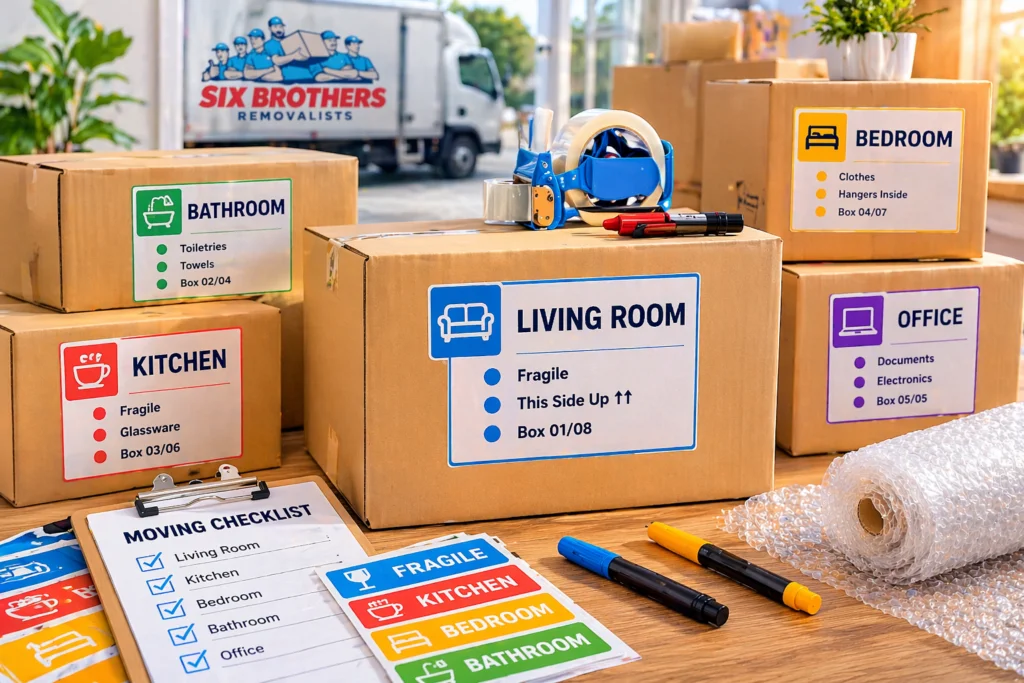
Label Every Box
Write the room and general contents on every box.
For example:
KITCHEN – GLASSWARE – FRAGILE
Or:
BEDROOM – WINTER CLOTHING – OPEN LATER
If a box contains fragile items, make this clearly visible.
Good labelling can save a surprising amount of time during unloading.
What Should You Pack Last?
Your everyday essentials should be packed last.
Prepare a separate bag or box containing the things you are likely to need immediately after arriving.
This could include:
- Phone chargers
- Toiletries
- Towels
- Basic cleaning products
- Toilet paper
- Tea and coffee
- Bottled water
- Snacks
- A change of clothes
- Important documents
- Basic tools
- Children’s essentials
- Pet supplies
Think of this as your first-night kit.
You do not want to search through dozens of boxes simply to find a toothbrush or phone charger.
How Much Does Moving House in London Cost?
The cost of a London house move can vary considerably.
There is no single price that applies to every property because several factors can affect the final cost.
These can include:
- Property size
- Number of belongings
- Number of movers required
- Distance between properties
- Amount of furniture
- Stairs
- Lift availability
- Parking
- Property access
- Packing requirements
- Furniture dismantling
- Moving date
- Additional services
For this reason, it is better to request a quotation based on your individual move rather than relying on a generic estimate.
How to Keep Your Moving Costs Under Control
You may be able to reduce your moving costs by:
- Decluttering before moving
- Packing your own belongings
- Preparing boxes before the movers arrive
- Disassembling suitable furniture
- Comparing detailed quotations
- Avoiding unnecessary last-minute services
- Booking your removal company in advance
However, price should not be your only consideration.
A removal service needs to have the appropriate people, equipment and vehicle capacity for your move.
How to Choose a Removal Company in London
Choosing the right removal company can have a major impact on your moving experience.
Do not automatically choose the cheapest quotation.
Instead, consider the complete service.
What Should You Look for in a Removal Company?
Look for:
- Experience with house removals
- Local knowledge
- Positive customer feedback
- Clear quotations
- Suitable removal vehicles
- Appropriate furniture protection
- Packing options
- Reliable communication
- Availability on your moving date
- Experience with difficult property access
Before booking, explain your moving requirements as accurately as possible.
Tell the company about the number of rooms, furniture, stairs, lifts, parking and any particularly large or fragile items.
This helps the removal team understand the work involved.
Looking for a Croydon Removal Company?
If you are moving within Croydon or relocating to or from the area, choosing a professional Croydon Removal Company can make the process easier.
Croydon has a wide range of residential properties, from flats and terraced homes to larger family houses. Each property can present different moving requirements.
For example, a move from a ground-floor property may be relatively straightforward, while moving from an upper-floor flat with limited access can require additional planning.
When comparing Croydon movers, consider whether the company can provide the services you need.
These may include:
- House removals
- Flat removals
- Furniture removals
- Packing services
- Loading and unloading
- Residential removals
- Office removals
- Student moves
- Long-distance removals
- Furniture dismantling and reassembly
The right service depends on your property and the amount of support you require.
Why Choose Alpha Removals for Your London Move?
Alpha Removals provides professional removal services for customers moving around London and surrounding areas.
When planning a move, choosing a removal company that understands the practical side of moving can make the day easier to manage.
You can learn more about Alpha Removals and its removal services by visiting Alpha Removals.
Before arranging your move, it is useful to provide the removal team with accurate information about your property.
Information to Give Your Removal Company
When requesting a quotation, consider providing:
- Current property location
- New property location
- Property type
- Number of bedrooms
- Number of floors
- Number of stairs
- Lift availability
- Parking information
- Large furniture details
- Approximate number of boxes
- Fragile items
- Preferred moving date
- Packing requirements
Accurate information allows the removal company to better understand your requirements and plan the move appropriately.
Moving From a London Flat
Flat removals can involve different challenges compared with moving from a house.
Before moving day, consider the following:
- Is there a lift?
- What size is the lift?
- Are there stairs?
- Are the staircases narrow?
- Is there a suitable loading area?
- Can the removal vehicle park nearby?
- Does the building have access rules?
- Is advance notice required?
- Are there narrow corridors or doorways?
If you are moving from an upper-floor property, make sure your removal company knows this before providing a quotation.
Large furniture can require additional planning when access is restricted.
Parking and Access on Moving Day
Parking is an important consideration for London removals.
A removal vehicle needs to be positioned as close to the property as reasonably possible so that furniture and boxes can be loaded and unloaded efficiently.
Before moving day, consider access at both addresses.
Check:
- Parking restrictions
- Loading areas
- Building entrances
- Narrow roads
- Driveways
- Gates
- Staircases
- Lift access
- Distance from the vehicle to the property
Tell your removal company about any potential access problems in advance.
If the removal team has to carry belongings a long distance from the vehicle to the property, the move may take longer.
What to Do on Moving Day
Moving day can be busy, but having a clear routine can help.
Before loading begins, make sure:
- Your boxes are packed
- Boxes are sealed
- Important belongings are separated
- Valuables are with you
- Pathways are clear
- Keys are accessible
- Your phone is charged
- Essential items are easy to find
Once the removal team has loaded the vehicle, check the property carefully.
Look inside:
- Wardrobes
- Cupboards
- Drawers
- Loft spaces
- Garages
- Sheds
- Storage areas
It is easy to overlook small belongings when you are concentrating on furniture and boxes.
Moving House With Children
Moving house can be a big change for children.
Depending on their age, involving them in small parts of the move can help them feel more comfortable.
They could:
- Help label boxes
- Pack some of their toys
- Choose items for their new room
- Prepare a personal bag
- Help organise their belongings
On moving day, keep their favourite toys, books and other familiar items accessible.
This can help make the new environment feel more familiar.
Moving House With Pets
Pets can become unsettled when their surroundings suddenly change.
Moving day involves open doors, unfamiliar people and lots of activity, so it is important to keep pets safe and away from the main moving area where possible.
Prepare a separate pet bag containing:
- Food
- Water
- Bowls
- Bedding
- Toys
- Leads or carriers
- Cleaning supplies
- Any necessary pet items
Once you arrive, give your pet time to become familiar with the new property.
What Should You Do When You Arrive at Your New Home?
Do not feel that you need to unpack everything immediately.
Start with the rooms and belongings you need most.
First Priority
Set up:
- Bedroom
- Bathroom
- Kitchen
- Children’s essentials
- Pet supplies
Once the basics are organised, you can start unpacking the remaining boxes.
Trying to unpack an entire house in a single day can leave you exhausted.
Give yourself time to settle in.
Common House Moving Mistakes to Avoid
Even a well-planned move can become stressful if important details are overlooked.
Leaving Packing Until the Last Minute
Trying to pack an entire property immediately before moving day can create unnecessary pressure.
Start early and pack gradually.
Forgetting About Access
Tell your removal company about stairs, lifts, narrow entrances and parking restrictions.
Moving Too Many Unwanted Items
Declutter before packing so you do not spend money transporting belongings you no longer need.
Failing to Label Boxes
Clearly labelled boxes make unloading and unpacking much easier.
Forgetting an Essentials Bag
Keep the things you need on your first evening separate from the main removal.
Choosing a Removal Company Based Only on Price
A quotation should be assessed based on what it includes, not just the headline price.
A Simple 7-Day London Moving Plan
If your moving date is only a week away, you can still create a simple plan.
7 Days Before Moving
- Confirm your removal company
- Review access and parking
- Begin packing remaining non-essential items
6 Days Before Moving
- Pack bedrooms
- Pack decorations
- Continue decluttering
5 Days Before Moving
- Pack books
- Pack storage areas
- Prepare suitable furniture for dismantling
4 Days Before Moving
- Pack most kitchen items
- Prepare cleaning products
- Separate important documents
3 Days Before Moving
- Finish most packing
- Label boxes
- Prepare your essentials bag
2 Days Before Moving
- Clean the property
- Check cupboards and storage
- Confirm your moving arrangements
1 Day Before Moving
- Pack your remaining everyday belongings
- Charge your phone
- Prepare keys and documents
- Get a good night’s rest
Moving Day
Keep your essentials nearby, communicate with your removal team and work through the move one stage at a time.
How Can Professional Movers Make Moving Easier?
A professional removal company can take care of much more than simply transporting boxes.
Depending on the service you choose, a removal team may assist with:
- Loading
- Transportation
- Unloading
- Furniture protection
- Furniture dismantling
- Furniture reassembly
- Packing
- Unpacking
- Heavy furniture
- House removals
- Flat removals
- Office moves
Professional support can reduce the physical work involved and allow you to focus on the other responsibilities associated with moving house.
For people moving in Croydon and other parts of South London, experienced Croydon movers can be particularly useful when a property has difficult access, stairs, limited parking or large furniture.
Why Local Experience Matters When Moving in Croydon
Croydon covers a wide area and includes many different types of residential properties.
A removal company may need to deal with anything from a straightforward house move to a complicated flat relocation.
Local knowledge can be useful when planning:
- Vehicle access
- Parking
- Property entrances
- Loading and unloading
- Stairs
- Lifts
- Large furniture
- Moving times
When comparing a Croydon Removal Company, ask practical questions before booking.
Questions to Ask Croydon Movers
Ask:
- How many movers will attend?
- What size vehicle will be used?
- Is furniture protection included?
- Are stairs included?
- Can furniture be dismantled?
- Is packing available?
- Are there additional charges?
- What does the quotation include?
- How long is the quotation valid?
- What happens if the move takes longer than expected?
Clear answers can help you choose a removal service that matches your requirements.
Final Thoughts: Make Your London Move Simpler
Moving house in London does not need to be an overwhelming experience.
The key is preparation.
Start early, declutter before packing, organise your belongings carefully and make sure your removal company knows about access, parking and furniture requirements.
If you are moving in Croydon, comparing experienced Croydon movers can help you find a service that suits your particular move.
For customers looking for professional removal support in London, Alpha Removals is one option to consider.
You can learn more about the company and its removal services at Alpha Removals.
With a sensible plan, clear communication and the right moving support, your 2026 London house move can be more organised, efficient and considerably less stressful.Frequently Asked Questions About Moving House in London
Start early, create a moving checklist, declutter before packing and organise your belongings room by room. You should also arrange your removal company and consider parking and access at both properties.
It is sensible to contact removal companies several weeks before your planned moving date. Booking early gives you more time to compare services and arrange a suitable date.
Compare companies based on experience, services, customer feedback, quotation details, vehicle options and availability. Also check whether they can handle your property’s access requirements.
Professional movers can handle flat removals, but you should provide details about the floor level, stairs, lift access, parking and entrances before requesting a quotation.
Declutter before moving, pack your own belongings where practical, prepare everything before the movers arrive and compare detailed quotations from several removal companies.